
Company events as an employee benefit in the Baltics
2026/05/26
Work is better when we do it together
Company events as an employee benefit in the Baltics
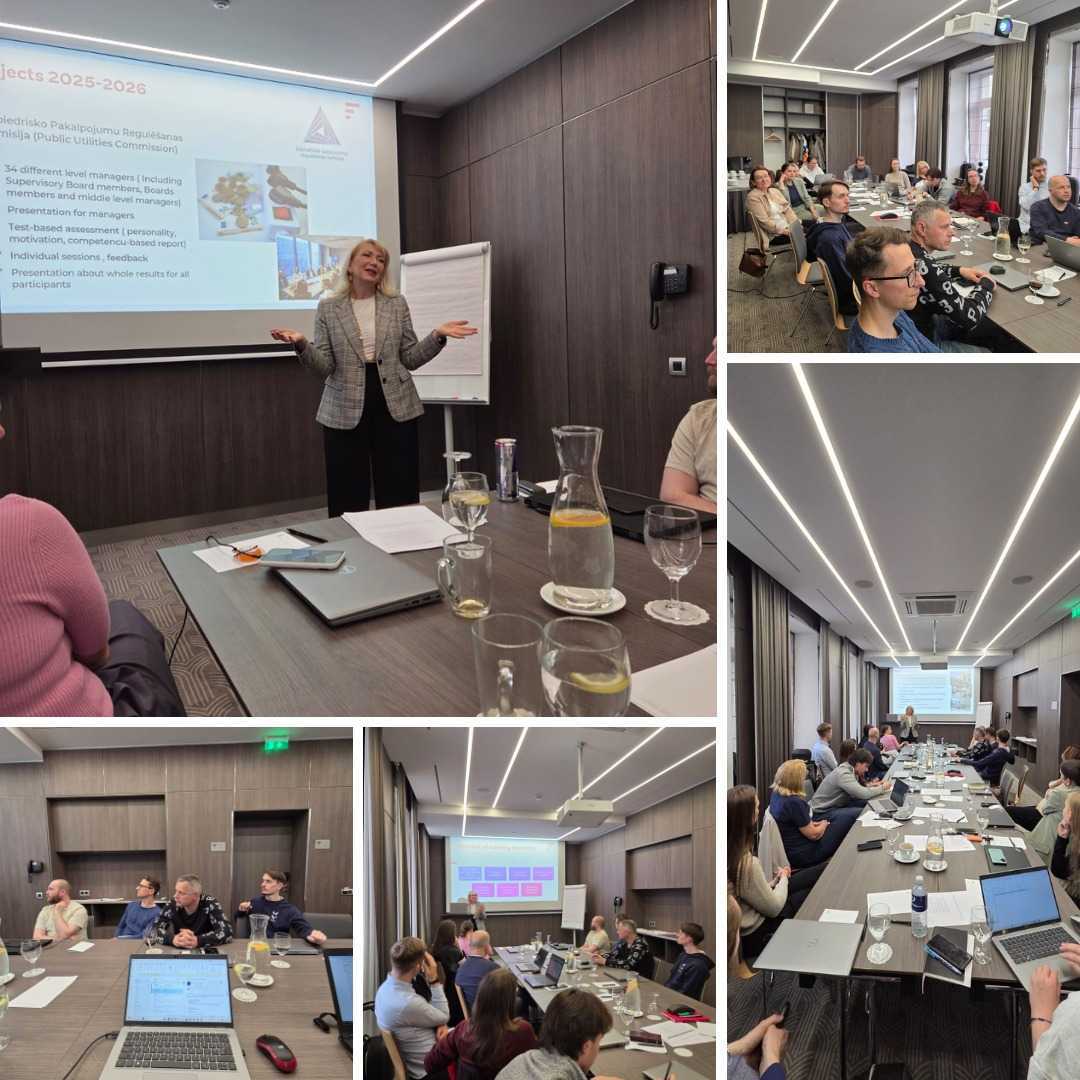
Figure Baltic Advisory is no exception. Three times a year, our Baltic team comes together — to discuss, learn and enjoy each other’s company.
A small photo memory from our latest gathering shows well that a company event does not always have to mean a big party. The photos turned out to be quite work-focused. And that feels right. Sometimes the most valuable part is simply that people can think together, talk, learn, laugh and feel for a moment that, although we work in different countries and different roles, we are working towards the same goal.
And work is better when we do it together.
Company events are sometimes seen as a “soft” benefit. Something that is organised when there is room in the budget and someone has time to arrange it. In reality, a company event is a much more meaningful tool for leadership and organisational culture. A well-designed company event helps build a sense of belonging, strengthen relationships and make collaboration easier.
People do not work only through processes. They work through relationships. Collaboration, trust, the flow of information and the willingness to help each other do not come only from job descriptions or organisational charts. They also come from whether people know each other, whether they feel comfortable reaching out to each other, and whether they feel that they belong to the same “we”.
The need to belong has been described in psychology as one of the fundamental human motivations: people have a strong need to build and maintain meaningful relationships with others. This need does not disappear when we enter the workplace. In organisations, a sense of belonging influences how people collaborate and how safe they feel among their colleagues.
Organisations that offer company events
Figure Baltic Advisory’s 2025 Compensation Survey benefit data shows that company events are an almost universal benefit among Baltic employers.
Entertainment and company events — such as sports events for employees, Christmas parties and other shared events — are offered to at least one employee group by 98% of organisations in Estonia, 96% in Latvia and 96% in Lithuania.
|
Country |
Organisations that offer company events to at least one employee group |
|
Estonia |
98% |
|
Latvia |
96% |
|
Lithuania |
96% |
This means that company events are not a rare or distinguishing practice used by only a few employers. They are a market norm.
When almost every employer offers something, the real question is no longer whether to organise company events. The question is what they create.
Do people get to know each other better? Do new colleagues find it easier to settle in? Do different teams, units or countries truly come together? Is it easier to reach out to each other the next working day?
A good company event is not just an item in the calendar. It is an opportunity to strengthen the connection that later shows up in everyday work.
How large is the company event budget?
Company events are a common benefit, but they are not just a symbolic line in an HR policy. Employers also allocate a meaningful budget to them.
For a simple Baltic comparison, we use one figure per country: the typical annual company event budget per person. This figure is based on the average of the median levels for managers, specialists and employees. It gives a clear general picture for the reader, although technically it is not a mathematical overall market median.
|
Country |
Typical annual company event budget per person |
|
Estonia |
€285 |
|
Lithuania |
€283 |
|
Latvia |
€220 |
These amounts do not represent the cost of one event. They represent the annual budget per person. This budget may be used for one larger company-wide event, several smaller team events, or a combination of both. In one organisation, it may mean summer days and a Christmas party. In another, it may mean quarterly meetings, team evenings, sports events or cross-country gatherings.
The typical budget level in Estonia and Lithuania is very similar — €285 and €283 per person per year, respectively. Latvia is somewhat lower, at €220. This does not automatically mean that one country organises better or worse events than another. The cost of an event depends on the format, number of participants, location, number of events during the year, whether family members are included, and whether the event is company-wide or organised as smaller team events.
What the numbers do show is that company events are not a minor side cost for employers. They are a meaningful part of the benefit package.
Why do organisations organise company events?
A good company event rarely has only one purpose.
First, it creates a sense of belonging. People want to feel that they are part of something bigger than their own tasks. This is especially important in organisations where people work across different countries, locations, shifts or functions.
Second, company events create informal relationships. Many collaboration problems do not arise because people do not know how to do their jobs. They arise because people do not know each other, do not know whom to contact, or do not fully trust the intentions of another unit. One shared day does not solve every problem, but it can make the next work-related contact much easier.
Third, company events help make organisational culture visible. Values do not live only on a website or in slides. They are seen in who is included, how people are listened to, whether leaders are genuinely present, whether new employees feel welcome, and whether the event creates space also for those who are not the loudest voices in the room.
Fourth, company events are a way to thank and recognise people. During the year, a lot of work quickly becomes “business as usual”. A shared gathering gives the organisation a chance to pause and say: we see your contribution.
Research on team development shows that team activities can have a positive impact, especially on attitudes, team processes and collaboration. The effect is stronger when the activity is not just “mandatory fun”, but supports goal clarity, relationships, role understanding or problem-solving.
A company event does not work if it becomes just another calendar obligation
There is also a risk with company events. The employer may see the event as a benefit, while employees experience it as an obligation.
This can happen when the event takes place at a time when participation is difficult. Or when the format suits only some people. Or when the whole event is built around alcohol or a late evening. Or when new people do not feel welcome. Or when the event is a convenient part of the working day for office employees, but for production, service or shift workers it means extra travel and giving up personal time.
That is why the question is not only about budget. The question is about experience.
Can people truly participate? Do they feel included? Does the event create new connections or simply reinforce existing groups? Can people say afterwards that they know their colleagues a little better?
If the answer is yes, then a company event is not just a nice day. It is an investment in collaboration.
The best company events build bridges
Over time, organisations tend to split into smaller worlds. Leaders talk to leaders. Sales talks to sales. Production talks to production. Office employees and frontline employees live in different information spaces. New people do not yet know the unwritten rules. In a Baltic organisation, it is also easy for “we here” and “they there” patterns to appear between countries.
One value of a company event is that it can move these boundaries, even if only for a moment.
Not necessarily through a big speech or a complicated programme. Often it is enough that people who would otherwise meet only by email or in a Teams call have a real conversation. This does not solve every collaboration problem, but it creates a small layer of trust that makes work easier later.
Research on social capital and HR practices shows that practices supporting relationships between employees can strengthen organisational social capital — the relationships, trust and networks through which work actually gets done.
What should an employer ask before the next event?
When planning a company event, it is worth starting not with the menu or the performer, but with the purpose.
- Do we want to thank people?
- Do we want to bring different teams closer together?
- Do we want to help new people settle in faster?
- Do we want to strengthen Baltic, cross-country or cross-functional collaboration?
- Do we simply want to create a moment where people can step out of their work roles and see each other as people?
All of these are good purposes. But they lead to different kinds of events.
One organisation needs a large shared event. Another needs smaller team events. A third needs more shared learning. A fourth needs a format that brings together office employees, production employees and people working in different locations.
The best company event is not necessarily the most expensive one. The best company event is the one that fits the organisation’s real need.
Company events as an employer’s promise
Company events do not replace good leadership, fair pay or a reasonable workload. If everyday working life is poor, one party will not fix the culture.
But in a good working life, company events have their place. They help create rhythm, celebrate, learn, thank people and maintain connections between people who may work in different countries, units, roles or shifts.
Figure Baltic Advisory’s experience is simple. We meet three times a year because we need to talk, learn, discuss and decide. But not only that. We also meet because we want to feel that we are one team.
And sometimes the most valuable things are the ones that do not fit into Excel: shared understanding, laughter, better contact and the feeling that, on the next working day, it is a little easier to reach out to each other.
Baltic employer data shows that company events are already an almost universal benefit. The next question is no longer only whether to organise them. The question is whether they are designed consciously enough to strengthen belonging, collaboration and the organisation as a whole.